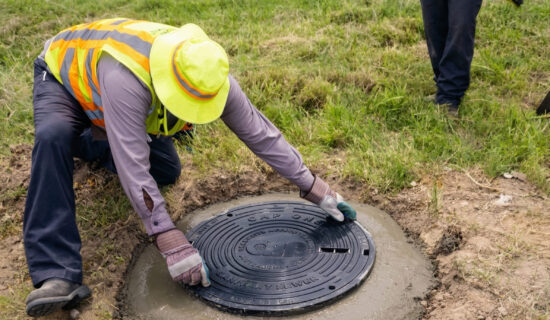

How to Buy the Most Resilient Manhole Cover Available
A manhole cover must keep water out, keep sewage in, support traffic loads, and allow safe access for crews. When covers fail, the consequences include stormwater inflow, corrosion, safety risks, and higher pumping and treatment costs.
That is why many municipalities are evaluating alternatives to traditional and specifying CAP® composite manhole covers. Engineered for durability, watertight performance, and manufactured in the USA, CAP® products are designed for long-term infrastructure reliability.
1. Watertight Performance and Inflow Prevention
Stormwater inflow, excess water entering the collection system through manhole covers during rain events, drives up pumping and treatment costs and contributes to sewer overflows into natural waters. Preventing inflow requires a cover that can achieve and maintain a watertight seal, not just sit over an opening.
CAP® bolted and gasketed covers are designed to stop inflow and prevent excess water entry. This performance depends on dimensional precision: CAP® composite covers are much more dimensionally precise and consistent than most traditional covers, due to the nature of the composite material compared with most other traditional processes, ensuring a reliable and repeatable fit between cover and frame.
Many operators report that it is rare when all four bolts will enter the cover holes and thread into the ring holes due to hole dimension and location variations of traditional materials.
Traditional cover corrosion can further undermine watertight performance over time. After a cover is removed for maintenance, it is very likely that the bolts are stuck in the bolt holes and cannot be reinserted, leaving crews unable to restore the watertight seal the system requires. CAP®’s 316 stainless steel hardware and corrosion-resistant composite frame eliminate this failure mode.
2. Material: Traditional vs. Composite

Material choice affects durability, safety, and long-term maintenance costs.
Most traditional covers are vulnerable to a specific biological corrosion process in sewer environments. Sulfate-reducing bacteria (SRB) convert sulfates to hydrogen sulfide (H₂S) gas. When released into the sewer atmosphere, it contacts Acidithiobacillus, a sulfur-oxidizing bacterium living above the waterline, which converts it into sulfuric acid (H₂SO₄).
This acid attacks iron through two mechanisms that cause sticking and seizing. First, when iron oxidizes, the resulting iron oxides occupy significantly more volume than the base metal, generating expansive forces that can displace or deform confined components. Second, the acidic sewer environment promotes the formation of iron sulfate (FeSO₄), a gummy, viscous byproduct that accumulates between mating surfaces, further binding the cover to the frame.
CAP® composite covers interrupt this corrosion cycle through two material-level advantages. First, their polymer-based structure naturally resists acids, acting as an inherent corrosion inhibitor against the sulfuric acid produced by Acidithiobacillus. Second, the continued conversion of H₂S to sulfuric acid at lower pH levels requires a secondary bacterium that depends on iron to drive the process further.
Without iron present in the cover or frame, that secondary reaction cannot be sustained, preventing the progressive pH drop and long-term deterioration seen in traditional cast iron systems.
3. Structural Performance and Durability
CAP® covers are engineered for consistent structural performance under real-world traffic conditions. With an approximate thickness of 4.5 inches, they achieve an ultimate load strength exceeding 100,000 pounds applied over an area equivalent to a single vehicle tire. F
or context, even the heaviest tractor-trailers typically exert no more than 7,000 pounds per tire, placing CAP® covers well within a safe operating range.
The combination of this thickness, CAP’s deep ribbed underside geometry, and a deep seating profile allows for efficient load distribution while maintaining stability under repeated traffic cycles. These deep ribs, a distinguishing feature of CAP® composite covers, help prevent molding-related warp, wobble, and displacement, while the overall structural design minimizes deflection and eliminates permanent deformation often seen in lower-grade composite or deteriorating metal covers.
4. Locking, Identification, and Customization
CAP® offers bolted systems, paddle locks, and quick-release mechanisms. One of CAP®’s fastener systems allows for pressure relief from storm surge and gas buildup without dislodging the cover and leaving a hazardous hole.
Covers can include molded-in utility identification, municipal logos, messaging, and vent holes. CAPs can be made with colored raw materials if the municipality desires that for easy identification.
5. Technology and Application Versatility

CAP® covers include a patented encapsulated during molding – not merely externally attached which exposes it to corrosion and impacts – neodymium magnet for detection with standard metal detectors (with only 316 SS hardware and composite materials, other options cannot be detected; the natural magnet actually amplifies the signal received by the detector to allow detection from 6–9 feet away), signal-transparent composite material, and RFID-enabled RF options for asset tracking.
CAP® covers are used across wastewater, stormwater, grease traps, telecom, and electrical vault applications, and feature molded-in – not drilled or machined – tech attachment points that allow CAP to install threaded inserts so sensors, meters, and transmitters can be bolted directly to the bottom of the cover without requiring antenna holes or externally mounted antennae.
6. Size and Load Rating
Selecting the correct size and load rating ensures both safety and regulatory compliance. Common sizes include clear openings of 24″, 30″, and 36″. CAP® offers multiple configurations, including CAP ONE 36, and meets AASHTO H-25 traffic ratings with unrestricted “within roadway” DOT approvals in the United States.
Made in the USA

CAP® products are manufactured in McAllen, Texas, with over 80% American-made raw materials, supporting BABA compliance, traceable domestic manufacturing, state DOT approvals, and 2–3 week lead times. Customers are invited to visit our U.S. operation for plant tours and quality inspections. CAP does not use third-party molders, so any concerns or improvements can be addressed quickly by our local team.
Lower-quality covers create recurring problems: corrosion damage, stormwater inflow, stuck covers, and ongoing maintenance costs. CAP® composite manhole covers deliver watertight performance, corrosion resistance, structural stability, reduced handling weight, and compliance with traffic and domestic manufacturing standards. When durability, compliance, and structural performance matter, specifying the right cover protects infrastructure investment and public safety.
Specify strength. Specify efficiency. Just CAP That!
Contact us to request specifications or discuss the right CAP® solution for your project.